Inverse Rendering for Modeling with Line Primitives
Abstract
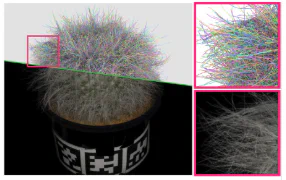
Faithfully capturing diverse real-world objects with fuzzy, anisotropic structures—such as hair, fur, fibers, and textiles—for efficient real-time visualization remains challenging. Recent radiance field reconstruction methods capture these structures from multi-view images using translucent volumetric primitives such as 3D Gaussians rather than opaque low-dimensional primitives (e.g., triangles, line segments, and polylines), thereby limiting compatibility with standard depth-tested rasterization, reflection modeling, and physical simulation. We present an inverse rendering method for reconstructing fuzzy geometry using explicit line segments, which are rasterized on a subpixel grid for anti-aliasing to reproduce a semi-transparent appearance. While straightforward to render, optimizing numerous line primitives to match target images poses a significant challenge. We address this by introducing a stochastic differentiable rasterizer for line segments that produces informative gradients with respect to vertex positions, attributes, and discrete connectivity. Experiments on synthetic and real-world datasets show that our method outperforms surface-based approaches in capturing fuzzy boundaries and achieves quality comparable to volumetric representations while relying entirely on explicit geometry. The resulting representation integrates seamlessly with standard graphics pipelines, enabling cross-platform rendering, various shading models, and physical simulation.
Kenji Tojo
Ph.D Course

Nobuyuki Umetani
Associate Professor
My research interests include interactive smart engineering design tool using physics simulation and machine learning.